I’m interrogating the language I’ve inherited.
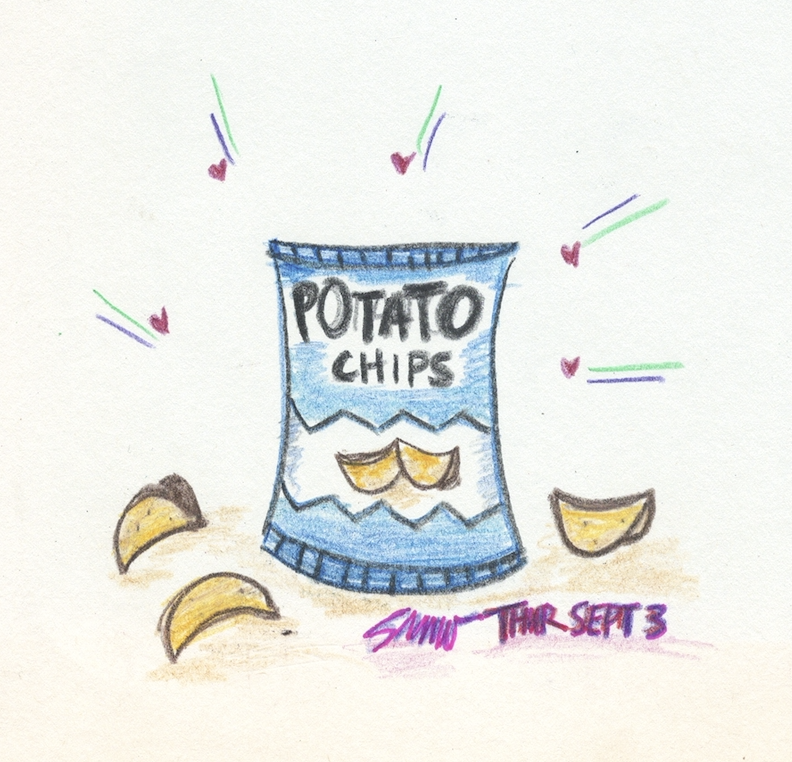
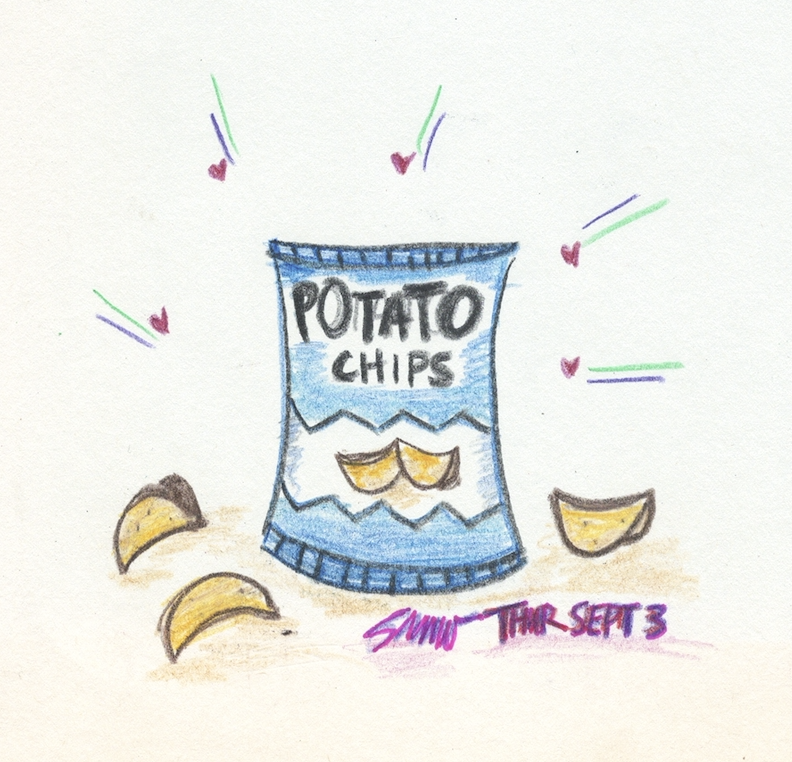
Drawing of a bag of potato chips with three chips laying on the table. Signed with author’s initials SMW on 9/3/26. A pdf with instructions for replicating this drawing is hyperlinked.
Stakeholder. Impact. Belonging.
I am looking to avoid these three words in co-creating an Annual Membership Survey with other members of the Society for Community Research & Action.
Here’s why.
It seems to me that we consume these words like potato chips …without even realizing how often we pick them up and swallow them down …without really thinking about where they came from and whether they have the nutrition we need.
I’m inviting us to ask what assumptions these widely used words carry with them.
Let’s start with STAKEHOLDER.
The term has become a catch-all for a variety of interested parties and assumes a particular relationship: I have a stake in this thing.
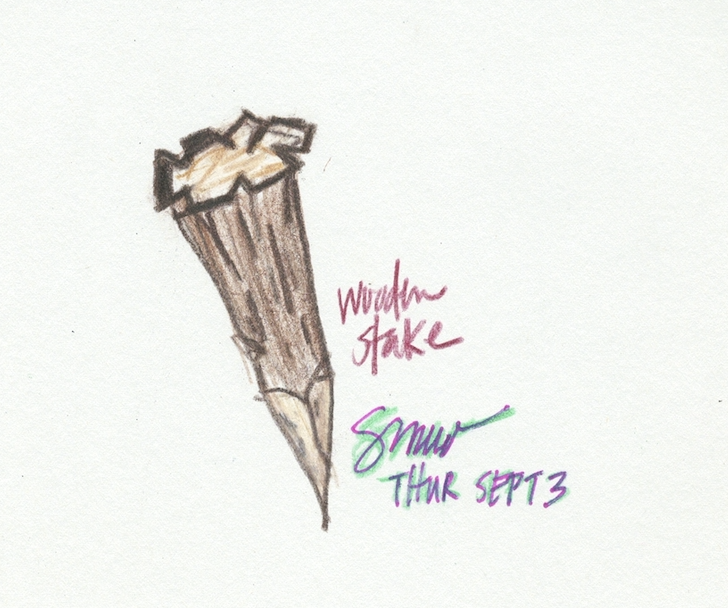
Drawing of a pointed stick labeled with the words “wooden stake.” Signed with the author’s initials SMW and the date THUR SEPT 3. A video showing how to replicate this drawing in hyperlinked.
However, calling Indigenous Peoples in Canada "stakeholders" is considered problematic because the term carries colonial connotations rooted in land dispossession. After reading commentary on the use of stakeholder from evaluators, health researchers, and other practitioners, I cannot unsee the image of a White settler driving a sharpened stick into the Earth to claim some piece of the land as his own.
The word stakeholder now puts my hackles up.
“The word stakeholder therefore has obvious negative connotations in an Indigenous context, and should not be used in referring to Indigenous Peoples, individuals or communities. Given its colonial roots, it’s best to avoid this term.”
If we are serious about community, participation, and shared power, why begin by imagining our members as people who merely have a “stake” in an organization? Let’s dream up some better descriptions of that relationship. I’d love to see your ideas in the comments.
Next: IMPACT.
Jara Dean-Coffey, founder of the Equitable Evaluation Initiative among other contributions, and John Kania, founder of the Collective Change Lab among other contributions, put their heads and hearts together to pull out impact as a word that could possibly limit the possibilities of social change efforts.
Upon reading the phrase “impacted tooth” in the piece they entitled 5 words that shape social change (and how they limit us), my jaw tightened. The word impact now makes me pull my shoulders up, bracing against the smack of non-consent.
“Remembering the word’s etymology helps to explain why having an impact has vastly different interpretations depending on your positionality. For well-meaning people in positions of power and privilege, the notion of impact might seem desirable. However, for people who are on the receiving end of impact strategies — people of color, immigrants or non cisgender individuals, for example — might feel the word smacks of presumption and non-consent, and may even find it offensive, triggering, or violent.”
If we are serious about progress, transformation, and thriving, why begin by imagining our legacy to be pushing really hard until we reach the breaking point?
I’m not saying that all existing structures and systems should stay intact. Some should not. But are there clever ways to dismantle, evolve, and expand that don’t involve forcing our way forward? It’s a fair question.
Finally, I’m resisting beginning with BELONGING.
Four to five years ago (2021-2022), I was leading a project alongside two cohorts of college and university settings where our goal was to center particular groups of students in their annual campus climate surveys. Essentially, we were prioritizing, instead of marginalizing, social identities and demographic groups within campus communities. One of our outcome measures was belonging.
Since that project concluded, I have continued to carry with me ideas that emerged from conversations about building supportive settings: maybe not every student or employee wants to belong.
My research partner Amber Wallace added the following question at the end of the section of the survey about belonging:
Overall, how important to you is a sense of belonging at [CAMPUS NAME]?
After she and I discussed our varied experiences of campus life — some shared, some divergent — we wondered whether all folks place the same degree of value on “belonging” to the campus community. Graduate students, as one example, might desire respect in the classroom and having access to high-quality professional and practical opportunities, without wanting a sense of group belonging.
During this same time (summer of 2022) as part of Omnigi’s OurStory series, Dr. Vernita Perkins prompted more careful and critical thinking about what we mean when we ask whether people “belong” to certain institutions.
There are important questions to be asked about why certain institutions are in the business of fostering a sense of belonging. Why do they want you to feel you belong? Is it a marketing technique in disguise?
Like brand loyalty, the effective manufacturing of a sense of belonging might benefit institutions more than individuals through renewed membership dues, new enrollments, increased donations, and other financial or in-kind contributions. In a world increasingly designed to maximize the number of seconds our eyeballs are focused on corporate content, belonging is at risk of being commodified, with various groups and organizations competing for you to belong to them.
Given an American history of chattel slavery and designating women and children as marital property, we need to be attentive to whether our language implies that members need to fit into, identify with, or be claimed by SCRA.
Finally, belonging can place the burden on the individual: Do you feel like you belong here?
The more interesting questions, to community psychologists, are relational and structural. We can look beyond the individual to ask whether SCRA creates conditions for meaningful connection, participation, reciprocity, and community:
How are you received? Whose knowledge is recognized? What relationships are possible here? What happens when you disagree? What do you have the opportunity to shape?
Word choice is important because the words we use to frame a survey shape what the results will be able to reveal. We want to understand people’s experiences of SCRA, but before we decide what to measure, we must envision members’ relationship to the organization and to one another.
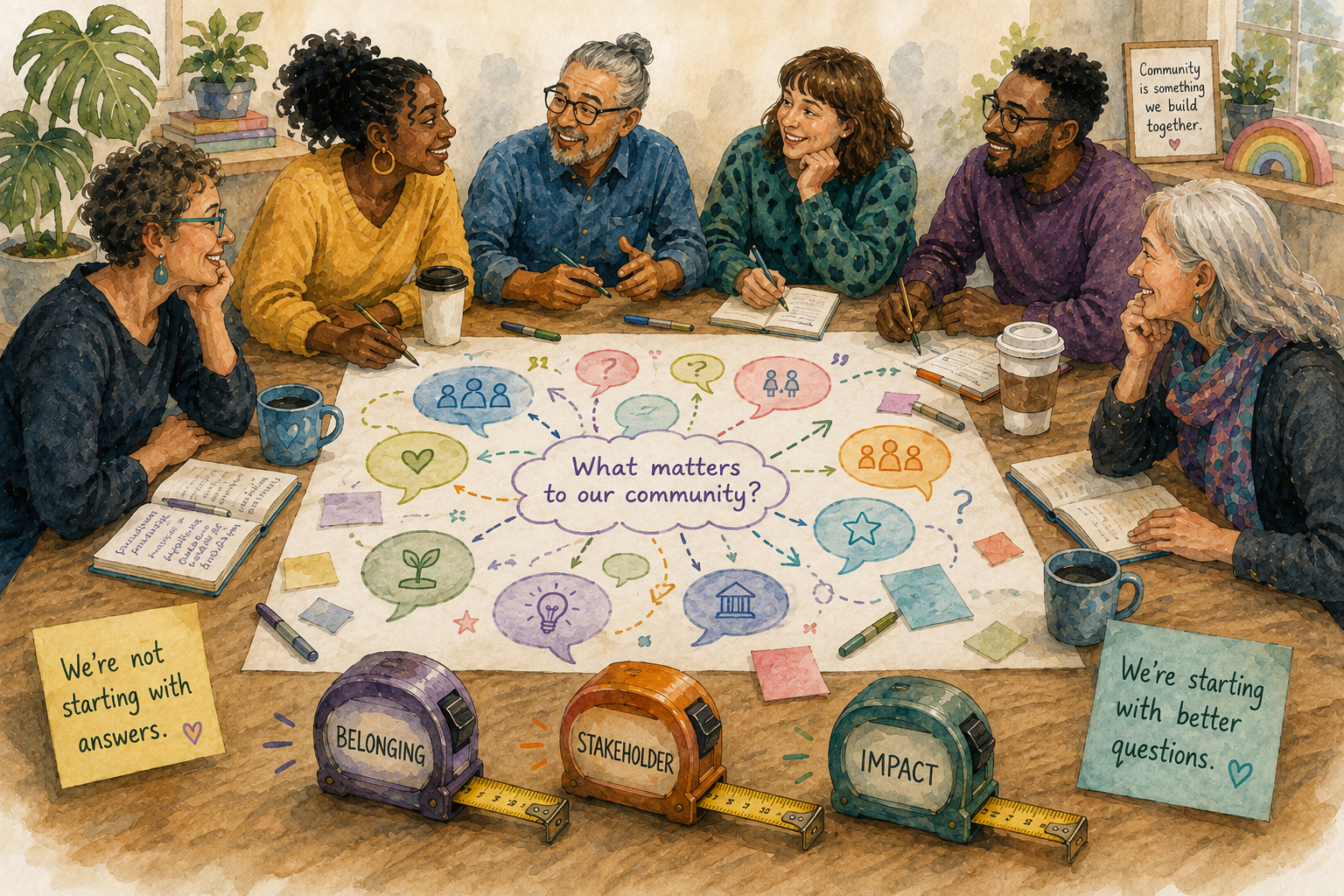
An image generated by ChatGPT depicts some of the ideas of this blogpost. At the forefront of the image are three unused measuring tapes labeled 1) BELONGING, 2) STAKEHOLDER, and 3) IMPACT. Six adults of varying age, race, and gender presentations are sitting at a table in a horseshoe-shaped half circle. They have pencils, notebooks, and coffee-cups near their hands and are leaning in, making eye contact, and smiling. They are dressed in work-appropriate, but not business, clothing and accessories (e.g., jewelry, eyeglasses). On the table at the center of the group is a large paper with “What matters to our community?” handwritten. Around the question, shared ideas are depicted with colored thought bubbles that evoke the SMW Consulting logo, arrows, drawings, and sticky notes posted to the sheet. A yellow sticky note says “We’re not starting with answers.” A blue sticky not says, “We’re starting with better questions.”
I think this survey can be less about:
How satisfied are you with your membership benefits?
And more about:
What does being part of SCRA make possible for you, and what kind of community experience does SCRA create?
Maybe that is what I’m really trying to do with these three words.
Not ban them. Not declare them wrong.
Just slow down long enough to ask what they make possible, what they obscure, and whose assumptions they carry with them.
Belonging. Stakeholder. Impact.
What might we see if we started somewhere else?
Chew on that.